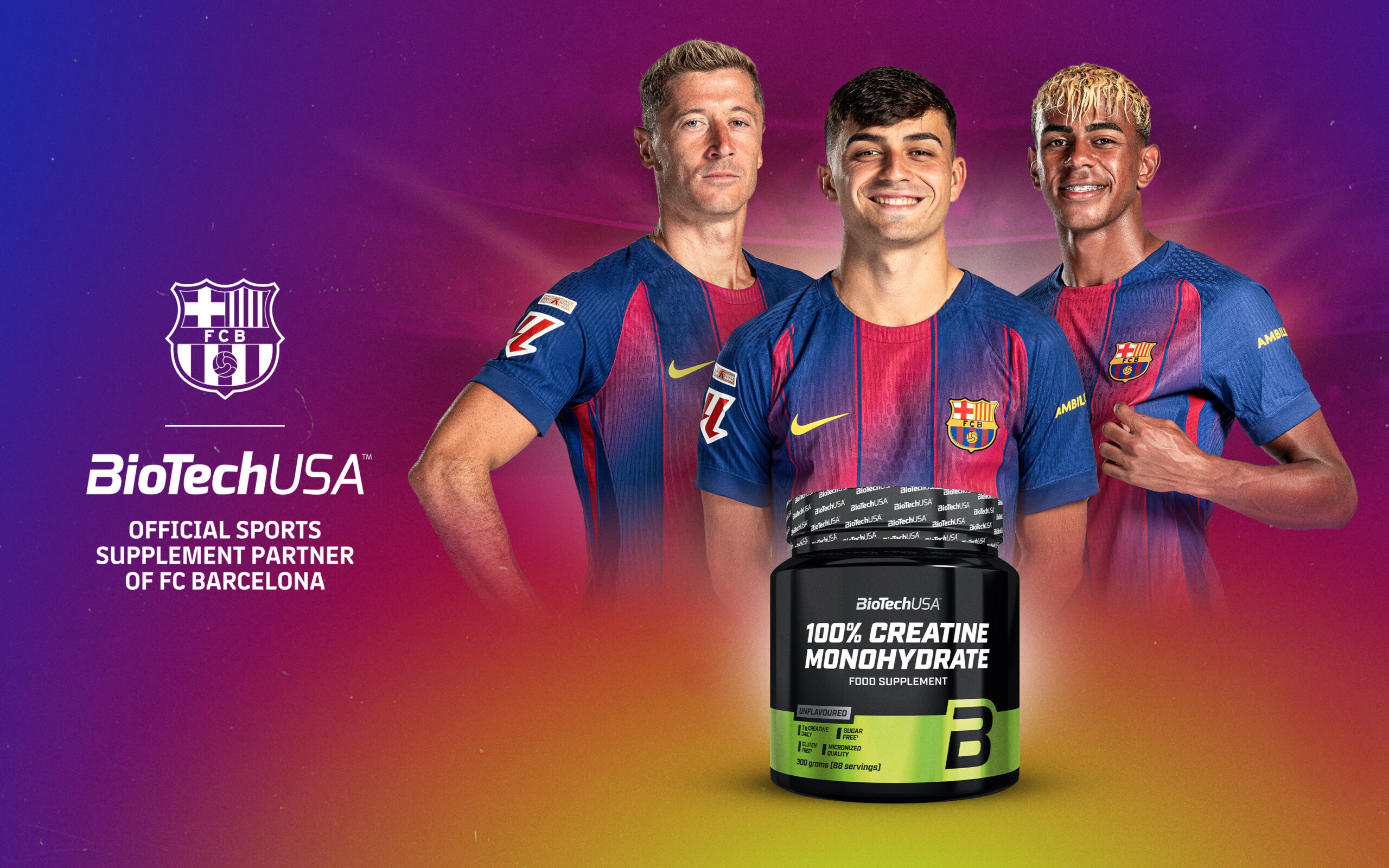
FC Barcelona conducted a case study of BioTechUSA’s product
The collaboration between BioTechUSA and FC Barcelona began in September 2024, meaning that the players of the world-famous Catalan club have been preparing for competitions with BioTechUSA’s products and expertise for more than a year. We reviewed the incorporation of creatine, a paramount supplement, into the daily lives of world-class players with Mireia Porta, head of FC Barcelona’s nutrition department, drawing conclusions from an entire season.
During the 2024–25 season, the players of FC Barcelona’s women’s and men’s first teams used BioTechUSA products on match days, during training sessions and during their recovery. It is important to note that these products are not specially tailored for the Catalan club; they are the same ones available to all customers across the world in BioTechUSA stores, webshops and partner networks. The collaboration involves more than just providing players with the necessary supplements; it also includes continuous measurement, analysis, and fine-tuning as part of the programme.
Continuous monitoring
All athletes undergo regular biomarker testings to ensure their diet is adjusted according to their current needs. These tests measure more than just macro- and micronutrient levels; they also monitor muscle regeneration, inflammatory processes and hormonal balance. This enables the club’s professional staff to determine precisely what type and quantity of supplementation is needed, and when it should be taken.
The inclusion of creatine monohydrate, an active ingredient in a BioTechUSA product used by FC Barcelona, is context-dependent: during pre-season, the focus is on adaptation and routine rather than higher doses. During the season, however, the dosage is continuous and moderate (3g per day), typically taken after training sessions or matches. At the peak of the season, when the team may be competing for up to three titles, the dosage remains stable to support recovery during periods of intense exertion. If players are injured, the dosage may be increased under medical supervision to moderate muscle loss and support recovery.
So, what exactly is creatine?
Creatine is an organic compound made up of three amino acids, produced by the liver, kidneys, and pancreas, and stored in large quantities in skeletal muscle, but also used by our muscles, heart, and brain for quick energy. It plays a vital role in the regeneration of adenosine triphosphate (ATP), which provides energy. This is the main reason why creatine has been used in sports nutrition for decades. Creatine is one of the most researched, safest, and most effective dietary supplements among athletes.
Its effects have also been recognized by the European Food Safety Authority (EFSA): 3 g of creatine per day increases physical performance during short-term, high-intensity training. In addition, it also helps to replenish ATP stores in the muscles and restore cellular energy levels, which is also important for regeneration, as confirmed by this study. Creatine can also be useful in preventing age-related muscle loss, in addition to exercise. According to a 2024 study, it increased muscle mass and strength in older adults, and the EFSA has also recognized that 3g of creatine per day can increase the effect of resistance training on muscle strength even in people over 55.
Creatine in football: suitable for men and women, regardless of diet.
“Many people still think that creatine is only for bodybuilders, but this is a misconception. It is one of the most important supplements in team sports because it supports rapid recovery, improves explosiveness and enhances mental alertness,” said Mireia Porta. She added that the latter is rarely mentioned, even though decisions in football are made in tenths of a second during a match and this amino acid can help maintain concentration in the 90th minute. Creatine is not only stored in the muscles, but also in the brain, where it plays a role in cognitive function.
One of creatine’s great advantages in terms of preparation is its flexible application time: although players often consume it after training with regenerative nutrition, its effectiveness is not dependent on strict timing. The key is regularity: consistent daily intake is essential.
For the club’s female players, particular attention is given to the luteal phase of the menstrual cycle, when hormonal changes can hinder recovery. Nevertheless, creatine supplementation continues throughout the entire cycle as it provides multiple benefits and plays a particularly important supportive role during the luteal phase.
The same applies to vegan and vegetarian athletes, who naturally have lower creatine levels due to their diet lacking animal-based food sources. According to experts, supplementation is practically essential for them.
Success through variable-intensity dosing.
It is important that creatine monohydrate is used continuously throughout the year, rather than occasionally. Consistency is key: creatine should be taken on training and match days, as well as on rest days, to maintain muscle saturation. The flexibility of the active ingredient means players can adjust their intake according to different situations without compromising its effectiveness.
This is invaluable for professional footballers, whose schedules are often crowded and unpredictable due to matches, training sessions, travel and media obligations.
Mireia Porta emphasises: ‘For our players, creatine is not an extra, but a staple. It is just as important as getting enough sleep or staying hydrated. Just as no athlete would take to the field without being well-rested, creatine supplementation has become equally indispensable. In modern professional sports, it is not just a dietary supplement; it is one of the cornerstones of performance and recovery.’
It’s not just sponsorship; it’s close professional collaboration.
The partnership between FC Barcelona and BioTechUSA is a prime example of how sports science, nutritional planning and premium supplements can be incorporated into daily training routines. The programme not only provides players with the necessary supplements, but also includes continuous measurement, analysis and fine-tuning. The relationship between the two parties is like a living, constantly evolving project that can adapt to every stage and challenge of the season.
Creatine monohydrate plays a pivotal role in this, as its creatine content helps to maintain physical and mental performance, accelerate recovery, and support muscle mass retention. These benefits are particularly evident during the busiest periods of the season, when players must perform at their best almost daily. According to the staff, regular creatine use also reduces muscle fatigue after matches, promotes longer-lasting mental freshness and lowers the risk of injury.